|
|
||||||||||||||||||||||||||||||||||||||||||||||||||||||||||||||||||||||||||||||||||||||||||||||||||||||||||||||||||||||||||||||||||||||||||||||||||||||||||||||||||||||||||||||||||||||||||||||||||||||||||||||||||||||||||||||||||||||||||||||||||||||||||||||||||||||||||||||||||||||||||||||||||||||||||||||||||||||||||||||||||||||||||||||||||||||||||||||||||||||||||||||||||||||||||||||||||||||||||||||||||||||||||||||||||||||||||||||||||||||||||||||||||||||||||||||||||||||||||||||||||||||||||||||||||||||||||||||||||||||||||||||||||||||||||||||||||||||||||||||||||||||||||||||||||||||||||||||||||||||||||||||||||||||||||||||||||||||||||||||||||||||||||||||||||||||||||||||
|
New Philadelphia : 2004 Archaeology Report |
|||||||||||||||||||||||||||||||||||||||||||||||||||||||||||||||||||||||||||||||||||||||||||||||||||||||||||||||||||||||||||||||||||||||||||||||||||||||||||||||||||||||||||||||||||||||||||||||||||||||||||||||||||||||||||||||||||||||||||||||||||||||||||||||||||||||||||||||||||||||||||||||||||||||||||||||||||||||||||||||||||||||||||||||||||||||||||||||||||||||||||||||||||||||||||||||||||||||||||||||||||||||||||||||||||||||||||||||||||||||||||||||||||||||||||||||||||||||||||||||||||||||||||||||||||||||||||||||||||||||||||||||||||||||||||||||||||||||||||||||||||||||||||||||||||||||||||||||||||||||||||||||||||||||||||||||||||||||||||||||||||||||||||||||||||||||||||||||
|
|
THE ARCHAEOLOGICAL EXCAVATIONS Paul Shackel
Please follow these links to view the sub-sections of this chapter
Following is an overview of the archaeology performed by the summer 2004 NSF-REU program. A large proportion of the archaeological data comes from the plow zone and is descriptive in nature, although we did discover several sub-plow zone contexts that reveal clues about the town’s growth and development. These features provide an opportunity to create a more detailed analysis of nineteenth- and early twentieth-century lifeways in New Philadelphia and they also allow us to move forward to nominating the town site to the National Register of Historic Places. Each year we will provide a general overview of the season’s work, and the final analysis will occur after the third and final year of the NSF-REU program.
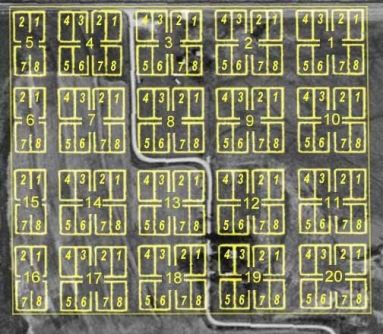
Methods Likes Land Surveyors, Inc. of Barry, Illinois assisted greatly in the exploration of New Philadelphia. They located the original plat and imposed the town plan over the existing topography, marking the boundaries of the town, blocks, and lots. Likes Land Surveyors, Inc. then produced a map, which was overlain on an existing aerial photograph (similar to Figure 3.1), which then guided our initial archaeological survey in the fall of 2002 and the spring of 2003 (Gwaltney 2004).
Figure 3.1. 1998 Aerial Photograph of New Philadelphia site with an overlay of the block, lot and street boundaries. The large numbers are the Blocks and the smaller numbers are the lots. (Image courtesy, Natalie Armistead and overlay by Christopher Fennell.)
In order to create an excavation and research strategy, the archaeology team decided that a pedestrian survey should be the initial phase of work. The survey would help find artifacts on the surface and allow the team to determine which areas were settled within the town proper. New Philadelphia is approximately 42-acres, and prior to this survey the archaeology team asked the New Philadelphia Association to plow the fields that have already been disturbed by prior agricultural activities. They plowed on the average of 0.25ft to 0.5ft deep and covered about 26 ½ acres. This plowing allowed for greater than 75% ground visibility in the fields. The archaeology team did not survey about 2 ¼ acres of protective prairie grasses that surrounded the several remnant foundations. About 3 ¾ acres of privately owned land did not get surveyed. An additional 9 ½ acres was not surveyed because of terracing for soil conservation, existing historic roads, tree cover, and coverage by part of an artificial pond. The walkover survey was conducted over the newly plowed fields (Gwaltney 2004). The walk over survey under the field supervision of Joy Beasley and Tom Gwaltney (see Gwaltney 2004) provides important information that furnishes artifact distributions over the site. The clustering of artifacts shows distinct patterns that are highly informative for understanding the town’s settlement (Figure 3.2). The analysis of the plow zone data indicates that there are large concentrations of artifacts found within the lots bordering along Broad Way and Main St. in Blocks 3 (lots 3-6), 4 (lots 1, 2, and 8), 7 (lot 1), 8 (lots 1-8), 9 (lot 5), and 13 (lots 3 and 4). Blocks 4 (1856), 8 (1844), and 7 (1854) have the earliest mean ceramic dates and Block 9 has a mean ceramic date of 1858. Very little work-related materials, like tools associated with blacksmithing, are present in the assemblage (Gwaltney 2004).
Figure 3.2. Distribution of historic artifacts found at New Philadelphia (from Gwaltney 2004).
Kitchen wares tend to have the higher proportion of artifacts in each of these blocks and it provides some indication that each of these blocks included domestic structures. A 1939 aerial photograph shows a domestic structure on Block 7, although the relatively larger proportion of architectural vs. kitchen artifacts identified may indicate that the structure was occupied for a relatively shorter time than the other houses. An oral history with one of the town’s neighbors suggests that the house was abandoned in the early twentieth century (Burdick 1992) and it was dismantled in the 1930s because of its derelict condition and the desire to transform the land into agricultural use.
While the archaeological data from the walk over survey are from a plowed context, the artifacts provide some very important information that guided our excavation strategies. This information indicates that there is a high probability of locating the past, domestic occupations of the town.
After determining the areas of highest artifact concentrations, a geophysical survey was performed by Michael Hargrave (CERL). This work indicates the presence of subsurface anomalies and it allowed the archaeology team to concentrate excavation units on more specific areas of the town site (see Hargrave report).
In general we have a very good sense of land ownership (based on deed research) and the general population of the town (based on census data). Based on the historical documentary evidence, archeological survey, and geophysical survey, the archaeology team chose to work in four areas of the town site, including: Block 3, Lot 4; Block 7, Lot 1; Block 8, Lot 4; and Block 9, Lot 5.
During five weeks of the 2004 summer field season students completely excavated 18 excavation units to subsoil or to the top of a feature. The nine NSF-REU students were divided into three teams with one supervisor for each team. The archaeology team used engineers scale since it is the most commonly used form of measurement in historical archaeology. The archaeology work then proceeded in two steps. First, a form of sampling using 5ft x 5ft excavation units retrieved data from the town lot and gave us a sense of the plow zone, subsurface features and artifact concentrations. Once we established a sense of subsurface artifact concentrations and feature locations, students proceeded with a larger block excavation using 5ft x 5ft excavation units. Since the area was mostly plowed, these excavations proceeded quickly until the archaeology team encountered subsurface features and/or undisturbed sub-plow zone stratigraphy. Features, such as pits, were bisected and excavated according to stratigraphy, and the team systematically collected samples for flotation in order to retrieve archaeobiological data.
The artifacts were analyzed and grouped into several megastrata. Megastrata I is a mixed context that includes the plowzone. Megastrata II is an undisturbed late nineteenth century context and megastrata III is a mid-nineteenth century context. The subsoil, where no cultural activities occurred is designated megastrata B.
Lab work and analysis After five weeks of fieldwork the teams performed five weeks of laboratory work and analysis at ISM with museum staff members serving as mentors. Students cleaned, labeled, and identified archaeologically retrieved data. The data were entered into a computer database. Students then performed a minimum vessel analysis for the archaeological materials found in undisturbed contexts. Students also learned stabilization procedures for archaeobiological specimens. Marjorie Schroeder (ISM) mentored students during the SEQ CHAPTER \h \r 1macrofloral analysis. The students processed soil samples through a flotation device in order to recover archaeobotanical remains, small-scale animal remains, and very small artifacts such as glass beads.
Terrance Martin mentored the NSF-REU students with the identification of animal remains and demonstrated various ways of categorizing anatomical elements as cultural entities (skeletal portions and butchering units), recognizing natural modifications (e.g., carnivore and rodent-gnawing) and cultural modifications (burning, sawed or chopped margins, and knife-cuts), and quantifying faunal assemblages in terms of specimen counts, minimum numbers of individuals, and biomass (Figure 3.3).
Figure 3.3. Dr. Terrance Martin, Curator, Illinois State Museum, Instructs students in faunal identification. (Courtesy, Paul A. Shackel.)
The development of collegial relationships and interactions is an important part of this NSF-REU project. For 10 weeks students worked together in a collaborative fashion, using scientific methods to collect data and analyze it. While we encouraged a sense of team work, mentors were always present showing students how to develop and change methods when necessary, analyze data, and think about the results of their work. This relationship ensured the development of student-faculty interaction and student-student communication.
THE REGIONAL ARCHAEOLOGICAL RECORD At present it is difficult to precisely identify the past occupants of each of the lots that we excavated. Recently, Natalie Armistead, a member of the New Philadelphia Association, has located the Hadley Township records, and once these are copied and transcribed we will have a better idea of the owners, renters, and general improvements to each of the lots that we studied. Below is a list of the deed transaction and the census data for each of the lots and blocks where the archaeology team worked. The deed information provides us with details of ownership for each lot. While ownership does not necessarily mean that the owners resided on that property, when we examine additional information, like census data, we become more confident in our ability to identify the particular occupants of a lot in different time periods. The Hadley Township tax records, once transcribed, will also be a tremendous help. While there still may be some remaining doubt about the identity of the family that occupied a specific lot and the chronology of occupation, nevertheless, a clearer picture of the site’s settlement patterns will develop.
While we know a tremendous amount about the McWorters and their association with the development of New Philadelphia, the archaeology provides a voice to the many occupants about whom we know very little. The archaeology helps contribute to the social history of the town and provides clues related to health, diet, social interaction and consumer behavior. For a more detailed description of the archaeology, see the Unit Summaries set forth in Appendix A. The following section is an overview of some of the features and artifacts found on the four lots in which excavations were conducted this summer. This section is then followed by a list of deed and census data and a description of the archaeology for each particular lot. This description helps us form a preliminary understanding of the use and development of these portions of the New Philadelphia town site.
AN OVERVIEW OF FEATURES AND ARTIFACTS - 2004 Robert Mazrim’s (2002:161-172) synthesis of historic sites found on the Illinois frontier provides a comparison for understanding the archaeology in New Philadelphia. His work focuses on the identification of features and artifacts found on Illinois frontier sites. While his work is helpful for understanding the earliest settlement of New Philadelphia, it also serves as baseline for the later archeological materials found at the site. Useful for this project is Mazrim’s (2002) identification of three types of feature pits that could be found in a rural frontier site. This information is used here as a guideline for the New Philadelphia site.
In frontier Illinois there may have been little need for refuse pits, but as towns developed refuse disposal became more prominent. Hogs and other wild animals, like dogs, raccoons and small rodents, may have roamed the grounds of New Philadelphia, devouring food remains. A preliminary review of the 2004 faunal assemblage shows a considerable amount of rodent gnawing. Other materials, such as ceramics, bottles, and architectural remains were probably disposed in areas farthest from the house and probably close to property boundaries. Whether a frontier, a developing rural community, or an urban area, pits such as cellars, storage areas, or privy vaults, would eventually be filled after their primary functional uses were no longer needed. This fill would still consist of surrounding soils and debris. Sometimes this filling occurred before abandonment of the original function, although in rural contexts it probably occurred more often after abandonment. For instance, a cellar pit may function as a place to store goods under the floor of a cabin, but after the building is abandoned and the cabin torn down or salvaged for materials, the cellar would be filled with either the remaining architectural debris, or with trash from the surrounding area. The identification of artifacts and their known manufacturing dates provides a good indication of the feature’s secondary use.
Houses The early settlement houses on the Illinois frontier tended to be log cabins. For instance, John Woods, an English immigrant who settled the area after the War of 1812, described in detail the 16ftx18ft log structure built by one of his neighbors. These early houses were generally one story. Two doors were placed on opposite sides of the house and the chimney placed at the end. The chimney was constructed of wood and plastered on the inside with either clay or loam. Stone or clay lined the hearth. Another cabin built in 1817 in the Wabash Valley was described as being 12ft x 14ft with an earthen floor. A chimney did not exist, but rather there was a space between the clapboards so that the smoke could escape. Some cabins also had a loft or attic space for storage (from Mazrim 2002:18-19).
Subfloor Pit Cellars Cellar pits tend to be geometric in plan and usually one to three feet below the plow zone. Phillippee and Walters (1986) note that some mid-nineteenth century sub floor features measured 5ft x 7ft, and most measuring 8ft x 12ft. Charles Faulkner (1986) observed pit cellars measuring 6.5ft x 5ft, 8ft x 8ft, and 10ft x 15ft. Mazrim (2000:163) notes that several frontier era pit cellars in Illinois measured from 3 ft to 9 ft wide by 6 ft to 11.5 ft long. These features tend to have flat bases and straight walls, although the sides may have slumped to provide a concave shape. The pit cellars tend to fall into two categories. The first are wide and shallow and could have been used as crawl spaces. The second type tends to be smaller and more regular in dimension, but deeper. Remains of such pits tend to extend 1.0 ft to 2.0 ft below the base of the plow zone.
At New Philadelphia archaeologists located one subfloor pit cellar in Block 9, Lot 5. It measured about 5.0 ft by 5.0 ft and existed to a depth of 0.5 ft below the plow one. This cellar pit may be shallower than the ones identified by Mazrim since the plow zone may be a bit deeper than most sites (see below for more detail). A structure stood over the feature until the 1940s and the feature was filled with surrounding trash related to a late nineteenth- and early twentieth-century occupation.
Exterior Crop-Storage Pits Exterior Crop-Storage Pits served to store fruits and vegetables during the winter months. A shallow hole would be excavated, crops stacked, and covered with straw, branches and soil to insulate it from frost. When the family needed food the covering would be pulled back in one section and vegetables could be retrieved. These pits are often found near wells or near fence lines and they tend to be more oval and/or oblong in shape when compared to pit cellars and can be up to 1.0 ft deeper than the base of the plow zone (Mazrim 202:163-165).
Privy Vaults Mazrim (2002:168) has identified several features that he has identified as privy vaults. While these features are difficult to identify it appears that many located in a rural setting may have been shallow and periodically shoveled out through a rear trap door. While they tend to be geometric in shape, they are also smaller in size when compared to pit cellars and they are no more that 1.0 ft deeper than the base of the plow zone. While expecting to find fecally-deposited seeds such as blackberry and raspberry, Mazrim suggests that these seeds are non-staple foods and are not a significant part of the frontier diet of the 1830s and 1840s.
Material Goods St. Louis served as a major port of entry for consumer goods for the region. Ceramics from Great Britain and redware and stoneware vessels from places like Louisville, Cincinnati and Pittsburgh found their way to the inland regions via St. Louis.
By the 1830s the markets expanded considerably. In 1832 steamboats connected to Chicago and eastern ports were connected to the Midwest via the Erie Canal and the city of Buffalo. Work on the Erie Canal in New York State eventually spurred canal projects in Illinois and eventually bound Illinois to northeastern markets.
By the 1850s the increased transportation and communications development effectively closed the Illinois frontier. For instance, in 1834 about 230 steamboats traveled through the Mississippi and its tributaries and by 1848 about 1,300 navigated through the waters.
In 1851, for example, Chicago shipped nearly 40 percent of the corn entering Buffalo, over 42 percent of the oat, over half the wheat, nearly 54 percent of the bacon and hams, nearly 57 percent of the beef, nearly two-thirds of the corn. Chicago, moreover, shipped over 22 percent of the furs, nearly half the hides, and over 99 percent of the buffalo robes (Davis 1998:358).
By the end of the decade Chicago shipped over 18 million bushels of grain. The Midwest economy became a major player in developing the American capitalist economy. The Illinois and Midwest region was no longer isolated and other regions depended on its products (Davis 1998).
Ceramics Stoneware and redware vessels are rare on Illinois sites that predate 1835 and their presence does not increase until steamboats commerce increases. “Food storage vessels consist of small to medium-capacity pots and jugs. Food preparation vessels consist primarily of multipurpose, deep kitchen bowls” (Mazrim 2002:217). Milk pans can also be found at sites, although their quantities are low. The lack of regional potters in the first quarter of the nineteenth century meant that crockery vessels are almost non-existent on these early sites. Many of these vessels do not appear in the archaeological record until about the 1830s (Smith and Bonath 1982:937). Illinois redware potters primarily made utilitarian kitchenwares prior to the 1840s, such as pots, bowls, and jugs. Local potters in the German communities of Quincy’s post frontier era provided the area with an array of objects for cooking such as pipkins, mush mugs, porringers, herb pots, or bean pots (Mazrim 2002:245, 265). The available redware assemblages became much more elaborate. Stoneware was not made in any quantity in Illinois until the mid-1830s (Mounce 1989). Food service vessels, such as table plates and bowls are prevalent on early nineteenth-century domestic sites. Chamber pots and apothecary vessels are also common, while yellowware vessels tend to be rare (Mazrim 2002).
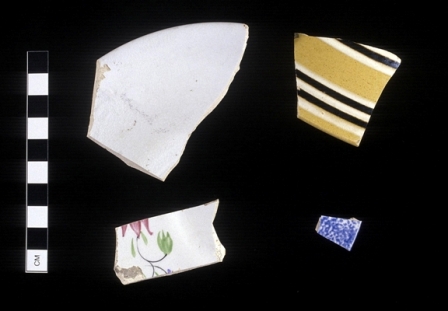
Yellowware is a simple hollowware form that was first manufactured in England in the late eighteenth century and by the 1830s potters in New Jersey and Vermont manufactured this type of ceramic. By the 1840s potters in Ohio and Indiana produced it, and by the 1850s potters manufactured it in Illinois (Ramsey 1939). By the mid- to late-nineteenth century yellowware (1830-1900) became a popular ceramic used as a container in the area of New Philadelphia. Several of these vessel types have a banded design. The largest quantity of utilitarian wares (used for food storage) found is buff pasted stonewares (1840-1900). Most of the refined earthenware ceramics (used for dining and serving) found at New Philadelphia tended to be undecorated whitewares (1820-1900) and a few transfer prints have been identified. The most common print design is blue, while pieces of brown, black, cranberry and green transfer prints are also present throughout the town. Most of the shell edge pieces are painted with molding (Figure 3.4).
Figure 3.4. Ceramics from the New Philadelphia site. Clockwise from top left: undecorated whiteware, banded yellowware, sponge-decorated whiteware, and hand painted whiteware. (Courtesy, Gary Andrashko, Illinois State Museum.)
Generally, the proportion of refined earthenware shards (and vessels from the features) is much higher than course earthenwares found at New Philadelphia. In the sites examined by Mazrim (2002:248) he finds that the ratio of refined earthenwares to utilitarian wares is no less than 5:1. While this ration might be surprising for sites established in a frontier context and counter our beliefs about life on the frontier, it is really the norm since these places were well connected to eastern ports. On the other hand, several sites in western Pennsylvania, dating to about 1790-1840 and closer to the eastern ports, have a much higher proportion of course earthenwares (Mazrim 2002). This phenomenon may be attributed to members of the German communities relying more heavily on established local redware potters for their tableware ceramics.
Glass Container glass is rare on pre-1835 rural sites in Illinois. The archaeological assemblages tend to be small, unidentifiable, and aqua shards. They are most probably medicine bottles or glass vessels used for household chemical products (Mazrim 2002:219). Olive green glass containers tended to hold wine and other spirits.
During the late nineteenth century occupation at New Philadelphia most of the container glass is highly fragmented from being part of the plow zone, and the original function is difficult to discern. There is a portion of an aqua green scroll flask container that would have come from a pear-shaped vessel with an oblong base. There are a wide range of scroll flasks manufactured in the middle of the nineteenth century, all with pear-shaped bodies and stylized designs. Some were made as early as the beginning of the 1830s and most were manufactured from 1840 to 1855 and were produced in the Midwest (Spillman 1883:38). At present we do not know if the original occupants transported this object when they came to New Philadelphia, or if it was purchased after the occupants settled the town. It was found in a late nineteenth-century context in Block 9, Lot 5. Since it was manufactured in the mid-nineteenth century and disposed of at a much later date it may have been a family possession for several decades before being discarded (Figure 3.5).
Figure 3.5. The remains of a scroll flask found in Block 9, Lot 5. (Courtesy, Gary Andrashko, Illinois State Museum.)
Glass lid liners are found throughout the entire town. Most are fragmented, although archeologists found a complete liner in Block 9, Lot 5. The lid liners are an indication of the wax seal technology that developed by the mid-nineteenth century. Glass jars were covered with matching glass or tin lids and a wax or grease element formed an airtight seal. John Landis Mason, a New York tinsmith, developed a process of pressing zinc lids for threaded canning jars. By 1868 the first glass inserts were developed by Salmon B. Rowley. They tended to be opaque milk glass. The screw lids with lid liners decreased the chances of spoilage and facilitated the canning process (Munsey 1970:146).
Activity Related Artifacts Activity related artifacts are found in relatively low frequencies during the frontier era, although the most common artifacts found are related to sewing, writing, grooming and leisure activities. Sewing related artifacts include straight pins, thimbles, small scissors, and spindle wheels. Straight pins often dominate the sewing assemblage and writing slate and slate pencils represents the writing category. Grooming related artifacts found at sites include fine-toothed combs (Mazrim 2002:221).
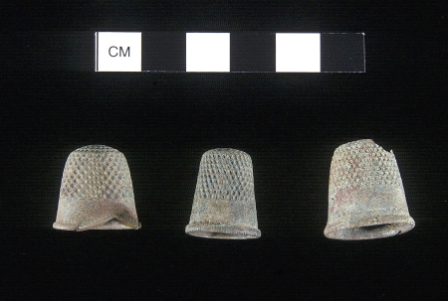
Many of these activity-related artifacts dating from the late-nineteenth-century occupation of New Philadelphia were more common in the archaeological record. Feature 1, related to the late nineteenth-century occupation of the Butler house on Block 9, Lot 5, contains 6 thimbles, a scissor handle, and milk glass, bone and shell buttons. There is one shell button platform that appears to have been broken during the manufacture of the button. A fine-tooth comb, also known as a lice comb, was also found. All of these artifacts are related to specific domestic and grooming activities (Figure 3.6).
Figure 3.6. Thimbles found in Feature 1, Block 9, Lot 5. (Courtesy, Gary Andrashko, Illinois State Museum.)
Leisure Activities Leisure activity artifacts generally include smoking pipes, gaming pieces and jaw harps. Smoking pipes are the most regionally diverse product. For instance, in the American Bottom the redware Moravian-type forms are common. These tend to have anthropomorphic figures, much like those found in the South Carolina region (Bivan 1972). In the Sangamon region the pipes tend to be undecorated redware elbow pipes. Mazrim (2002:221) believes that a local potter John Elby may manufacture these. The English long stem white kaolin pipe is also present in the region. White kaolin pipes are also found in the Wabash Valley region (Mazrim 2002:221).
New Philadelphia has a mix of both terracotta (described above as redware) and kaolin pipes. While the assemblage was fragmented, the four terracotta bowl fragments are from different individual pipes (Figure 3.7). There are two kaolin pipe fragments. It appears that finding a mix of kaolin and terracotta pipes is common for this region of Illinois (Smith and Bonath 1982:954).
Figure 3.7. Redware bowl fragments from the New Philadelphia site. (Courtesy, Gary Andrashko, Illinois State Museum.)
Very few jewelry pieces are part of the New Philadelphia assemblage and they are mostly beads, and only two are black, while another is milk glass. A crinoid (fossil) found in a historic context may have been used as a bead. The surface collection yielded two Job’s Tear beads.
Archeologists found several toy objects throughout the site. In Feature 1 of Block 9, Lot 5, archaeologists found a miniature pewter toy set that included a pitcher and an urn. In Block 3, Lot 3, they uncovered a glazed multi-colored large marble and one whole and one fragment of an unglazed kaolin marble.
DETAILED DESCRIPTION OF THE BLOCK AND LOT EXCAVATIONS Block 3, Lot 4 The deed and census data indicates that Frank McWorter sold Block 3, Lot 4 to Henry Brown in 1838. There are 10 transactions involving the lot in the following 100 years. While detailed information exists on the life of Frank McWorter (see Walker 1983), little information survives for the subsequent occupants of the lot. Using the deed and census data (see below) we can infer that the Clark and Hadsell families owned and occupied the site. While William Welbourne purchased the lot in the twentieth century he and his family appear in the 1880 Federal Census. The deed and census data related to Block 3, Lot 4 follow. The names italicized are those who may have occupied the lot.
DEED TRANSACTIONS
1850 FEDERAL CENSUS
1855 STATE CENSUS
1860 FEDERAL CENSUS
1865 STATE CENSUS*
(*the name Jesse Hadsell in the deed transaction can be either J.P Hadsell or James Hadsell. Both are listed here)
1870 FEDERAL CENSUS
(Clark and Hadsell appear in the census data, but the first names do not correspond exactly with the deed records.)
1880 FEDERAL CENSUS
Note: Kasiah Clark, probable mother of Alexander Clark (in the 1850 census), is listed as mulatto, 76 years of age, and living in the Louise McWorter household.
Archaeology for Block 3, Lot 4 Following is a summary of the archaeology for Block 3, Lot 4. (For a more detailed technical overview see the Unit Summaries in the appendix.) The archaeology team excavated a total of six units (Figure 3.8). Four of them, Excavation Units 3, 4, 5, and 6, formed a larger block that measure 10.0ft by 10.0ft and enabled the team to fully expose Feature 2. The surface grade of the site slopes from the center of the town that is adjacent to Broad Way to the west. Generally the topsoil of the plow zone ranges from a black (10YR 2/1) to a very dark grayish brown (10YR3/2). The depth of the plow zone averages about 1.0ft to 1.2ft below the surface (Figure 3.9). Artifacts, from the plowzone, designated megastratum I, are small, most no larger than 0.5 inch in diameter. The uniform small size of the artifacts is a result of continuous plowing. Diagnostic artifacts from the plow zone include cut nails (with dates ranging from 1790-1880) and ceramic whitewares (1820-1940). In this mixed context archaeologists found a 1903 Illinois State Fair pin, thus demonstrating that this site was occupied into the early twentieth century.
Figure 3.8. Location of excavation units in Block 3, Lot 4. (Courtesy, Likes Land Surveyors, Inc.)
Figure 3.9. North wall profile for Excavation Unit 3 in Block 3, Lot 4. Notice the slopes from west to east. (Image enhanced by William White.)
Archaeologists uncovered a lime slacking pit (Feature 2) in Excavation Units 3, 4, 5, and 6, below the plow zone (Figure 3.10). This feature measures 2.8ft by 4.4ft and was dug into the soil and subsoil and served as a basin for mixing lime and other materials to create an aggregate for plastering interior walls. The edge and top of the feature is about 0.4ft higher than the deepest part of the basin. Artifacts in close proximity to the lime pit are from the plow zone and have a mean ceramic date that ranges from 1805 through 1870. The earliest dated artifacts are pearlwares, and date to the earliest settlement era, and the later dated artifacts are whitewares, and are probably related the late nineteenth and early twentieth-century occupation of the site. While the excavation units are located in a plowed field, the existence of the lime pit indicates that a structure with plastered walls once existed nearby (Figure 3.11). Additional excavations in the area may uncover sealed contexts and the remains of an associated structure. These investigations will provide information about the use of the lot and the lifeways of the site’s former inhabitants of Block 3, Lot 4.
Figure 3.10. Planview and profile of the lime pit in Excavation Units 3, 4, 5, and 6 in Block 3, Lot 4. (Image enhanced by William White.)
Figure 3.11. Mapping in the remains of the lime pit. (Courtesy, Paul A. Shackel.)
Summary Coring For Block 3, Lot 6 The geophysical survey located several anomalies throughout the site (Figure 3.12). Using a 1 inch diameter core, archaeologists sampled the area in a systematic fashion. Each soil core probe is labeled by transect and core number (i.e. T1N1, T1N2, T2N1, T2N2). Transects 2 through 4 are located in 5 ft intervals west of transect 1 (Figure 3.13). Soil color, depth of stratigraphy, and any physical resistance to the core probe were noted for each sample.
Figure 3.12. Electromagnetic survey indicating several soil anomalies. (From Hargrave 2004. Grid overlay by Christopher Fennell.)
Figure 3.13. Soil core survey of Block 3, Lot 6 in the area of Anomaly J. Pt. 897 marks the southeast corner of the lot. (Drawn by Christopher Fennell.)
Anomaly A is located on the west portion of the Block 3, Lot 7, and related elements of this anomaly appear to extend across the area once covered by High Alley and into the eastern edge of Block 3, Lot 6 (Figure 3.14). Four transects of six cores ran in a north-south direction at five ft. intervals. The southern most part of T1 is 25 ft north and 5 ft east of the southeast corner of Block 3, Lot 6. Core sampling hit resistance in two clustered areas: one in the north section of transects 2 and 3 and one along the southern most part of transect 2.
Generally, each core sample reached a depth of about 1.8 ft below the surface. The uppermost layer consists of a 10YR3/2 (very dark grayish brown) and is located to an average depth of 0.9ft to 1.0 ft below the surface. This soil is the plow zone. The subsoil underlies the plow zone and it consists of a 10YR 3/2 (very dark grayish brown) mottled 10YR 4/3 (brown). Some resistance occurred at the north and southern portions of the ft below the surface, and in T1N5, and T1N6 resistance occurs at 0.65ft below the surface. This resistance may have been part of the anomaly area detected by the geophysical survey. In the southern section, which includes T2N1 through T2N3, the top soil layer consists of a 10YR3/2 (very dark grayish brown). Resistance to the probe occurred at an average depth of 0.6ft below the surface. Archaeologists placed one excavation unit that encompassed T1,N2; T1,N3; T2,N2; T2,N3. The unit was not completed by the end of the fieldseason (Figure xx).
Figure 3.14. Location of Excavation Unit 1 in Block 3, Lot 6 in the area of Anomaly J. (Courtesy, Likes Land Surveyors, Inc.)
Block 7, Lot 1 The earliest recorded sale of Block 7, Lot 1, occurred in 1848 when Frank McWorter sold the property to James Pottle. In total there are over 20 transactions involving this property until 1930. The purchasers of the property also found in the census data include: Pottle, Luce, Squire McWorter, and William Hadsell. There is strong likelihood that at least some of these families lived on this lot. The deed and census data follow and the italicized names are those that may have resided on the lot.
DEEDS
1850 FEDERAL CENSUS
1855 STATE CENSUS
1860 FEDERAL CENSUS
1865 STATE CENSUS
1880 FEDERAL CENSUS
Archaeology for Block 7, Lot 1 The structure identified on Block 7, Lot 1, on the 1939 aerial photograph and described by Burdick (1992) (see below and see Background History Chapter) was known as the Betsy house. The area has a heavy concentration of artifacts and the walkover survey indicates the presence of a small amount of early nineteenth-century ceramics and a significant number of artifacts dating to the late nineteenth century. Archaeologists worked on two excavation units in Block 7, Lot 1, in order to locate the structure and find features that may provide clues about nineteenth-century lifeways and the landscape (Figure 3.15 and 3.16). Excavation Unit 1, placed on the edge of the artifact concentration revealed by the walkover survey had very few artifacts (Gwaltney 2004). The plow zone extended to a depth of 1.1ft below the surface. This soil tended to be a very dark grayish brown (10YR3/2) silty loam and silty clay. Subsoil exists below the plow zone.
Figure 3.15. Location of excavation units 1 and 2 in Block 7, Lot 1. (Courtesy, Likes Land Surveyors, Inc.)
Fig 3.16. Screening for artifacts at Block 7, Lot 1. (Courtesy, Gary Andrashko, Illinois State Museum.)
In Excavation Unit 2, artifact density increased significantly and the plow zone exists to a depth of about 1.3ft below the surface. The soil tended to be a very dark grayish brown (10YR3/2) and archeologists located the remains of a fieldstone foundation, designated as Feature 3 (Figures 3.17 and 3.18). The soils next to the fieldstone foundation appear to be in an undisturbed cultural layer and many of the artifacts from this context date to the late nineteenth century. While Burdick (1992) observed that the earliest portion of the Betsy House dated to the middle of the nineteenth century, the foundation remains located by archaeologists may be the result of a late nineteenth-century addition. A local resident remembers tearing down a derelict house in the late 1930s/early 1940s and removing the fieldstone foundations (see oral history section). The foundation stones are below the plow zone and may not have been removed because they were below the plow zone. Because this foundation was probably substantial and deeper than a foundation that would have supported a cabin, the foundation is probably related to a late nineteenth-century substantial addition to the earlier structure. A mid-nineteenth century foundation likely would not have been as deep or as substantial as this foundation.
Figure 3.17. North Wall profile of Excavation Unit 2 in Block 7, Lot 1. (Image enhanced by William White.)
Figure 3.18. Planview of Feature 3 in Excavation Unit 2, Block 7, Lot 1. (Image enhanced by William White.)
Block 8, Lot 4 The earliest known deed transaction that we identified for Block 8, Lot 4, is an 1871 sale from James Vokes to Solomon McWorter. A resurvey of the primary data in the Pike County Courthouse may provide evidence of an earlier transaction. There are 18 transactions for this piece of property through 1930. Several of these families, including Solomon McWorter and Frederick Shipman, also appear on the 1880 Federal Census that includes New Philadelphia, and there is likelihood that the Shipman family lived on the site. The deed and census data follow.
DEEDS
1865 STATE CENSUS
NAME FIRST NAME RACE no. in household McWorter S. B 5
1880 FEDERAL CENSUS
Archaeology for Block 8, Lot 4 The archaeology team performed a core sample survey and opened three excavation units in Block 8, Lot 4. Mr. Burdick (1992) recalls this block as being unoccupied through the twentieth century and he referred to it as “The Park.” The impression is that the area may have never been occupied. A review of the earliest surviving Hadley Township records dating to 1867 indicate that Block 8, Lot 4 was not improved. However, after the archaeological survey, the team concluded that Block 8 has a high potential for locating archaeological remains associated with the early settlement of the town. Block 8 had one of the largest concentrations of artifacts on the entire town site and based on the surface survey finds, it had a mean date of occupation is 1864 (Gwaltney 2004). The geophysical survey (see Hargrave, this report) also located several anomalies in Block 8, Lot 4 (Figure 3.19).
Figure 3.19. Resistivity Survey locating several soil anomalies found in Block 8, Lot 4. (From Hargrave 2004.Grid overlay by Christopher Fennell.)
Anomaly C identified in the geophysical survey is located in the southwest portion of Block 8, Lot 4. Three transects of nine core samples were placed in a north-south direction at five ft intervals. The southern most part of transect 1 (T1) is 20ft north and 25 ft west of the southwest corner of Block 8, Lot 4 (Figure 3.20). Of the 27 core samples, physical resistance to the core probe occurred in 10 of the sample points. The majority of these are located in the northern portion of the tested area. Generally, each core sample reached a depth of 1.8 ft to 2.1 ft below the surface. The upper most layer consists of a 10YR 3/2 (very dark grayish brown) and is located to an average depth of 1.0 ft to 1.1 ft below the surface. This soil is the plow zone. The subsoil underlies the plow zone and it generally consists of a 10YR 3/2 (very dark grayish brown) mottled 10YR 4/3 (brown).
Physical resistance to coring mostly occurred in the northern portion of the cored areas (T1N8, T1N9, T2N7, T2N8, T2N9, T3N8, T3N9) (Figure 20). Archeologists hit resistance at a depth that ranges from an average of 0.65 ft to 1.5 ft below the surface.
Figure 3.20. Coring performed near Anomaly C. (Drawn by Christopher Fennell.)
Considering this information, the archaeology team placed three excavation units where we determined the greatest possibility of locating undisturbed archeological features. Generally, in all three excavation units the plow zone exists to a depth of about 0.8ft below the surface. It consists of a very dark grayish brown (10YR3/2) silty loam (Figure 3.21). The artifacts ranged from the earliest settlement, although the heaviest concentration of artifacts in this layer appears to date to the post-bellum era. Underneath this layer is a buried horizon of soil that consists of a brown (10YR4/3) silty clay. Archeologists located a large concentration of brick fragments and stones that measured 0.25ft to 0.5ft in diameter. This large concentration of debris is anomaly C detected in the geophysical survey. This buried undisturbed horizon with debris is about 0.7ft deep and it contains artifacts that date to about the 1840s and 1850s. The quantity of artifacts dramatically increased in the lower part of the layer as archaeologist came closer to the top of Feature 4 (Figure 3.22 and 3.23).
Figure 3.21. Location of three units excavated in Block 8, Lot 4. (Courtesy, Likes Land Surveyors, Inc.)
Figure 3.22. North wall profile of Excavation Unit 1, Block 8, Lot 4. (Image enhanced by William White.)
Figure 3.23. Photographing wall profile in Block 8, Lot 4. (Courtesy, Paul A. Shackel.)
The western portion of feature 4 was exposed although the full extent of the feature could not be determined during the 2004 field season. The western edge of the feature is about 8.0ft long (in the far eastern portion of Excavation Units 1 & 3) and is located in the entire Excavation Unit 2 (Figure 3.24). The top of the feature appears to be a pit feature, although at this time, with a limited amount of the feature exposed, archaeologists cannot determine its original function. Its secondary use is probably a trash pit or used as a receptacle for building debris after the structure was destroyed and/or dismantled. Because of the overlaying sealed context of 1840s/1850s artifacts, it is probable that the original function of the pit feature is related to very early development of the town. Even though the earliest known deeds for Block 8, Lot 4 date to 1858, and the tax records from 1867 show that the lot was not improved, the archeological evidence indicates that the area was used as a domestic place, probably as early as the 1840s. The structure was probably dismantled before the Civil War. Additional work, such as expanding this block excavation, will help determine the age and function of the feature and perhaps provide more information about the early lifeways in New Philadelphia.
Figure 3.24. Plan of Feature 4 in Excavation Units 1, 2, and 3 in Block 8, Lot 4 found in the location of Anomaly C. (Image enhanced by William White.)
Block 9, Lot 5 Frank McWorter sold Block 9, Lot 5 to Kizie Clark in 1854. While Kizie Clark does not show up in the census records, the name Kizie likely stands for Casiah Clark, who was noted in the 1850 federal census. In 1888, Thomas Clark, Casiah’s son and listed as 11 years old in the 1850 federal census, sells the lot to William Butler. Clark and Butler appear in the census records and we are quite certain that at least the Butlers resided in New Philadelphia on Block 9, Lot 5. Following are the deed and census information.
DEEDS
1850 FEDERAL CENSUS
(**Note: Kizie Clark is probably Casiah Clark)
1880 FEDERAL CENSUS
Archaeology For Block 9, Lot 5 Excavation Units 1, 2, & 3 The walkover survey indicates that Block 9, Lot 5, had a very large concentration of artifacts with a mean ceramic date of 1859. The 1939 aerial photograph of the property also shows a structure in the southern and western edge of Block 9, Lot 5. By that time the structure served as a storage place, and the main domestic dwelling inhabited by the Butlers no longer survived on the landscape. Because of the high density of artifacts, and the probability of finding a domestic structure in the area, a geophysical survey was performed on Block 9, Lots 4 & 5 by Hargrave (2004) in April, 2004 (Figure 3.25). Hargrave identified several anomalies in the southwest corner of Block 9, Lot 5 in the approximate location of the structure identified on the aerial photograph. This area is also where the archaeological survey team found the high density of artifacts (Figure 3.26).
Figure 3.25. Resistivity survey of Block 9, Lot 5. (From Hargrave 2004. Grid overlay by Christopher Fennell.)
Figure 3.26. Location of units excavated in Block 9, Lot 5. (Courtesy, Likes Land Surveyors, Inc.)
Excavation Units 1-3 were placed in an area where these three sets of data suggested the presence of a domestic occupation. Generally, the plow zone exists to a depth of about 0.8ft to 0.9ft below the surface. The soil tends to be a very dark grayish brown (10YR3/2) silty loam and clayey silt. Large quantities of brick and mortar as well as household goods are present. Under the plowzone archeologists noticed a darker colored soil (10YR3/2 – very dark grayish brown) when compared to the surrounding subsoil (10YR4/4 – dark yellowish brown) and designated this area as Feature 1. Most of the feature lies in Excavation Unit 2. The western boundary is in the eastern half of Excavation Unit 1 and the northern portion of the feature is in the southern part of Excavation Unit 3 (Figures 3.27 and 3.28). The entire feature measures about 5.0ft by 5.0ft and it extends to a depth of about 0.5 ft below he plow zone. It has a concave shape. The archaeology team bisected the feature on a north-south axis and excavated the western portion. Soil samples were also retrieved for flotation. The materials from the feature date to the late nineteenth century and are predominantly from the Victorian era. The material objects include miniature pewter toys, a large quantity of buttons and thimbles, as well as ceramics, glassware, and iron hardware.
Figure 3.27. Plan view of Feature 1 in Excavation Units 1, 2, and 3, in Block 9, Lot 5. (Image enhanced by William White.)
Figure 3.28. Profile of Feature 1 in Block 9, Lot 5. (Image enhanced by William White.)
During the excavation of the pit feature a local resident visited the site and remembered walking past the structure daily in order to attend the New Philadelphia schoolhouse in the 1930s (Figure 3.29). He described the structure in the location of Excavation Units 1-3 as small and very old with a metal roof and an overhang on the north side. He remembered the structure as dilapidated and in poor repair (personal communications, William White).
Figure 3.29. Identifying the boundaries of Feature 1, Block 9, Lot 5. (Courtesy, Paul A. Shackel.)
At present we know that the artifacts from the feature date to the Victorian era and these materials were probably from a refuse scatter or pile close to the structure. The building may date to as early as the mid-nineteenth-century and may have been built by the Clark family. The structure was not removed until after 1939. After its removal the surrounding soils with Victorian era artifacts were deposited into the feature. Because of the dates associated with the artifacts there is strong possibility that the artifacts are associated with the Butler occupation of the late nineteenth and early twentieth centuries.
Since the excavations in Block 9, Lot 5 produced a significant number of artifacts from a pit feature, archaeologists conducted soil core sampling in order to locate additional features and possibly define foundations associated with the structure. Two transects of 19 cores each ran in a north-south direction at 5 ft intervals (Figure 3.30). The southernmost portion of transect 1 (T1) is 20 ft north and 20 ft east of the southwest corner of Block 9, Lot 5. The southernmost portion of transect 2 (T2) began 20 ft east of T1, and T2N1 is located 20 ft north and 40 ft east of the southwest corner of Block 9, Lot 5.
Figure 3.30. Coring transects in Block 9, Lot 5. (Drawn by Christopher Fennell.)
Generally, each core sample reached a depth of 1.8 ft below the surface. The uppermost layer consists of a 10YR 3/2 (very dark grayish brown) soil and is located to an average depth of 0.9ft below the surface. The soil is the plow zone. The subsoil underlies this layer and generally consists of a 10YR 4/4 (dark yellowish brown) or 10YR 4/3 (brown) mottle 10YR 3/2 (very dark grayish brown).
Resistance to core probe mostly occurred in the northern portion of T1 and through the majority of T2. At T1N14, T1N15, T1N16, and T1N19, and T2N2, T2N3, T2N4, T2N7, T2N10-T2N17 resistance occurred at an average depth of 0.5 ft below the surface. At T1N1, T1N17, T2N18, T2N9 resistance occurred at a depth that ranged from 1.0ft to 1.5ft below the surface. Because of this resistance the archaeology team placed several excavation units along the two transects in order to determine that nature of this coring anomaly (see Excavation Unit Summaries). Originally, the archeology team believed that this resistance may be a stone feature, like a fieldstone foundation. The archaeological investigations revealed that hard-packed clay caused the resistance.
Other Excavation Units Because of the coring results and the resistance found in several cores, archaeologists decided to work and decipher the meaning of these anomalies. Excavation Units 4, 5, 6, & 7 were placed in areas where the 1 inch diameter core met resistance. The plow zone varied considerably in this area and subsoil exists anywhere from 0.5ft to 1.0ft below the surface. The soil tends to be very dark grayish brown (10YR3/2) silty loam, and the subsoil is a dark yellowish brown (10YR4/4). The area where the subsoil is closer to the surface may have occurred because of erosion. After excavating these units, archaeologists determined that hard packed clay caused the high resistance during the coring. This area had significantly fewer artifacts than found in the area of Feature I (Excavation Units 1, 2, & 3).
SUMMARY AND SUGGESTIONS FROM THE 2004 SEASON The original archeological survey (Gwaltney 204) and the geophysical survey (Hargrave 2004) helped to guide the first season’s excavations. Concentrations of artifacts in the blocks along the northern portion of Broad Way and the intersection of Broad Way and Main Street provides some clues about the settlement pattern of New Philadelphia. Most of the town’s residential occupations occurred along this corridor.
According to the census data for Pike County, there is a significant change in the number of occupants per dwelling from the early nineteenth century through the end of the century. From 1850 through 1890 the average number of persons per dwelling dropped by one person, from 5.97 to 4.78, and the mean family size decreased from 5.89 to 4.68 (Smith and Bonath 1982: 79-80). The change in the average size per household occurred because of the drop in family size and the decrease in the number of households that practiced having extended families under one roof. Therefore, there is a good chance that while the population for New Philadelphia dwindled, and the average size of the households also decreased, the number of dwellings would not have declined in relative proportion. Over the next several years there is a good likelihood that the archaeology will reveal many of these dwellings and outbuildings.
Excavations indicate that the plow zone is about 1.0 ft to 1.2 ft deep throughout New Philadelphia and it is a bit shallower in the northern portion of Block 9, Lot 5. The archaeology work demonstrates that undisturbed archaeological features exist below the plow zone in each of the four areas that we tested, and thus the site is eligible to be nominated to the National Register of Historic Places. These features taken together span the entire time period of the town’s occupation. One feature, a filled pit, dates to the 1850s or earlier (Feature 4), another pit feature (Feature 1) related to the Butler household’s late nineteenth and early twentieth century occupation. A lime slacking pit (for the mixing of lime for the plastering of interior walls) is located in Block 3, Lot 4, and is associated with a yet to be discovered nineteenth-century building. A stone foundation also exists in Block 7, Lot 1 and is probably a late nineteenth-century addition to a mid-nineteenth century building. At this time precise dating of these two latter features is tentative, but they are both related to the nineteenth-century town (Figure 3.31).
Fig 3.31. Team Z of the New Philadelphia NSF-REU Program. (Courtesy, Paul A. Shackel.)
Almost all of the nails found at the houselot sites are machine cut nails. They were generally manufactured from about 1790 to about 1880. In the 1880s wire nails become popular and they are still manufactured today. The lack of wire cut nails provides some perspective about the growth and eventual demise of the town. Little building and very little repairs occurred to the existing buildings in New Philadelphia after the 1880s. While the residents of the former town left, people apparently did not build or renovate existing structures. The town suffered a slow decay as families moved away and buildings disappeared from the landscape.
The artifact assemblages found at the different parts of the town also help to paint a different picture of the end of frontier Illinois. While there is a common perception of frontier life with little amenities, this is not the case as the town developed in the 1840s, 1850s, and after the American Civil War. Very early in the town’s existence the residents were well connected with regional and national markets. Refined earthenware ceramics from Great Britain found in contexts that date to the 1840s/1850s provide notable evidence of the purchasing networks necessary to provision material items to this town located over 20 miles from the Mississippi River. Agents from St. Louis traveled to eastern ports and ordered large quantities of ceramics to be shipped to St. Louis for eventual distribution to the city’s hinterlands. By the 1850s goods easily flowed from Chicago.
The presence of an aqua green scroll flask container fragment that dates to about 1850 is also an intriguing object. It was made in the Midwest and while the object may suggest the opening of regional trade routes during this era to places like Louisville and Cincinnati, its presence may also be attributed to the strong local connection that residents maintained during the town’s early settlement (Figure 3.32).
Figure 3.32. Excavations at New Philadelphia. (Courtesy, Paul A. Shackel.)
The sewing assemblage from the Butler house furnishes a context for domestic life of a late nineteenth-century African-American family. The identification of slate pencils (found in Block 9, Lot 5) close to the area where local accounts locate the site of a past, segregated school house that served African-American residents (on Block 9, Lot 4) provides notable evidence of the presence of this institution and the use of this structure by members of the community. However, future excavations need to concentrate on the old schoolhouse lot (Block 9, Lot 4) to further investigate that site.
It becomes clear when comparing sites from the early nineteenth century in Illinois that many forms of material culture become homogenized and earlier cultural differences become indistinguishable (Mazrim 2002:268). While “Yankee” and “Upland South” traditions are noticeable in the faunal assemblage (see Martin, this report), a review of the material goods uncovered to date shows that the types of material culture found at sites inhabited by different ethnic groups show little or no differences. All of the residents of New Philadelphia have the same types of material culture and could access local merchants for goods, such as refined earthenwares. What distinguishes the different households from each other may be their dietary habits. Lack of access to some markets, because of economics, transportation, and/or racial discrimination may have encouraged some families to continue the tradition of relying on foraging and hunting for a substantial amount of their protein intake (see Mullins 1999). A closer and more detailed examination of house construction techniques may also provide some clues about household and ethnic differences.
Additional archaeology and a more detailed analysis of artifacts and features will help provide a foundation for additional interpretations of the lifeways of the residents of New Philadelphia.
REFERENCES CITED Gwaltney, Thom 2004 New Philadelphia Project Pedestrian Survey: Final Report and Catalog. Phase I Archeology at the Historic Town of New Philadelphia, Illinois. ArGIS Consultants, LLC, Bethesda, MD. (http://www.heritage.umd.edu/CHRSWeb/New%20Philadelphia/NP_Final_Report_View.pdf )
Hargrave, Michael 2004 Geophysical Investigations at the New Philadelphia Site, Pike County, Illinois. U.S Army Engineer Research and Development Center, Construction Engineering Research Laboratory, Champaign, IL (http://www.heritage.umd.edu/CHRSWeb/New%20Philadelphia/2004%20report/Geophysics%20Report%20Menu.htm)
Mazrim, Robert
Mullins, Paul R. 1999 Race and Affluence: An Archaeology of African America and Consumer Culture. Kluwer Academic/Plenum Publishers, New York, NY.
Munsey, Cecil 1970 Illustrated Guide to Collecting Bottles. Hawthorn Books, New York.
Ramsey, John 1939 American Potters and Pottery. Hale, Cushman, and Flint, Clinton, Massachusetts.
Spillman, Jane Shadel 1983 The Knopf Collector’s Guide to American Antiques: Glass Bottles, Lamps &Other Objects. Alfred A. Knopf, NY. |
||||||||||||||||||||||||||||||||||||||||||||||||||||||||||||||||||||||||||||||||||||||||||||||||||||||||||||||||||||||||||||||||||||||||||||||||||||||||||||||||||||||||||||||||||||||||||||||||||||||||||||||||||||||||||||||||||||||||||||||||||||||||||||||||||||||||||||||||||||||||||||||||||||||||||||||||||||||||||||||||||||||||||||||||||||||||||||||||||||||||||||||||||||||||||||||||||||||||||||||||||||||||||||||||||||||||||||||||||||||||||||||||||||||||||||||||||||||||||||||||||||||||||||||||||||||||||||||||||||||||||||||||||||||||||||||||||||||||||||||||||||||||||||||||||||||||||||||||||||||||||||||||||||||||||||||||||||||||||||||||||||||||||||||||||||||||||||||