|
Archaeologists and Interpretation
Public interpretation of
archeological resources involves selecting different
aspects of the past and different perspectives to reach
a greater understanding of past human behavior.
Interpreters also have a wide range of formats available
for public programs. Through these efforts, interpreters
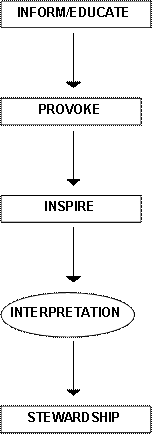
seek to:
 |
Inform/educate
park visitors how and what has been learned from
archeological study |
|
|
Provoke
visitors to establish their own intellectual and
emotional connections with archeological resources
|
|
|
Inspire
public awareness of and appreciation for cultural
resources stewardship
|
A Harris poll
commissioned by the Society for American Archaeology
revealed great interest in archeology by the public
along with misconceptions about what archaeologists do
and why. These findings emphasize the importance of more
effective interpretation of archeological resources.
Advances in
archeological method and theory over the past 30 years
have made the field of archeology more specialized.
Archeological reports often are highly technical and
written to satisfy legal requirements under
environmental review and historic preservation laws.
Furthermore, despite legislative and professional
requirements to promote the public benefits of
archeology, many archeologists lack the resources and
appropriate training to convert technical reports into
“user-friendly” documents. Instead, archeological
information often is available in forms that many
interpreters, not to mention the public, find difficult
to muddle through.
 The
specialized, technical, and academic basis of
archeological research also has led many an archeologist
to cringe at the prospect of presenting archeological
information in the form of a “historical narrative” or
using “first person” accounts to elicit emotional
connections with the past. Thus, interpreters generally
lack readily available information on cultural resources
in forms that are directly presentable to the public. The
specialized, technical, and academic basis of
archeological research also has led many an archeologist
to cringe at the prospect of presenting archeological
information in the form of a “historical narrative” or
using “first person” accounts to elicit emotional
connections with the past. Thus, interpreters generally
lack readily available information on cultural resources
in forms that are directly presentable to the public.
Archeological research
in the United States is increasingly funded in part with
public monies as a result of the inclusion of cultural
resource reviews under environmental and historic
preservation laws. Thus, archeologists, too, have
initiated training and development in public outreach
within the ranks of the profession through the National
Park Service and in professional associations (although
academic training in public interpretation still lags
behind). Thus, interpreters should find increasingly
willing partners amongst archeologists to develop
effective means to reach the public about the importance
and meaning of cultural resources.
Building on increasing
interest by archeologists in promoting the public
benefits of archeology, archeologists and interpreters
can achieve effective interpretation of archeological
resources by training and working together. |